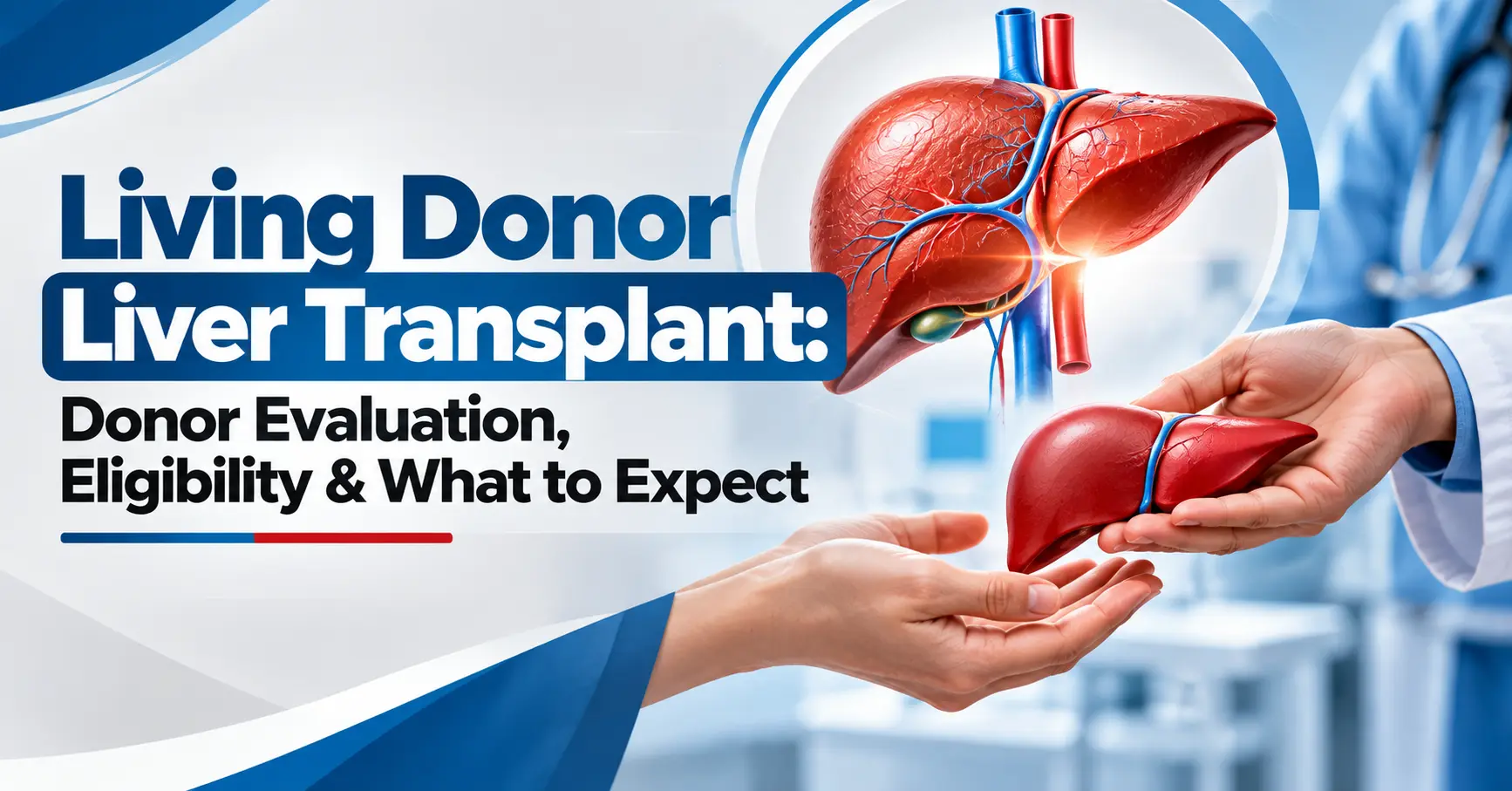
Living Donor Liver Transplant in Kochi: Donor Evaluation, Eligibility & What to Expect
A living donor liver transplant in Kochi may be considered when a suitable living donor is available for a patient who requires liver transplantation. In this approach, a healthy donor undergoes surgery to donate a portion of the liver, which is then transplanted into the recipient. Because the donor is undergoing major surgery without a direct medical benefit, donor safety and careful donor evaluation are central to the process.
At Digestive & Liver Care Clinic (DLC), Dr. Harikumar R. Nair provides transplant-hepatology care that includes living donor evaluation, pre-transplant assessment and coordination with transplant surgical centres.
A potential donor is not accepted simply because they are a family member or are willing to donate. Medical fitness, liver health, liver anatomy, graft suitability, psychological readiness and the applicable legal requirements all need to be considered. AASLD guidance similarly emphasises comprehensive donor evaluation and donor safety in living donor liver transplantation.
What Is a Living Donor Liver Transplant?
In living donor liver transplantation, surgeons remove a suitable portion of a healthy donor’s liver and transplant it into the recipient.
The exact portion removed depends on factors such as:
- Donor liver anatomy
- Donor liver volume
- Recipient size
- Required graft size
- Blood-vessel and bile-duct anatomy
- Surgical planning
For adult living-donor transplantation, the transplant team may consider an appropriate liver-lobe graft based on the donor and recipient’s individual anatomy.
The 2025 AASLD/AST adult liver-transplant guideline specifically identifies living donor liver transplantation as an option that should be discussed with appropriate transplant candidates, while emphasising adequate graft size, donor-graft quality and surgical-centre experience.
The donor’s remaining liver and the transplanted portion also regenerate and increase in volume after surgery. Mayo Clinic explains that the donor’s liver generally grows back toward its usual size within a few months.
Why Is Donor Evaluation So Detailed?
A potential donor may be healthy and have no significant symptoms, but that does not automatically make donation safe.
The donor evaluation has to answer several questions:
Is the donor healthy enough for major surgery?
Is the donor’s liver healthy enough to donate?
Is the liver anatomy suitable?
Can enough liver remain safely with the donor?
Will the graft be adequate for the recipient?
Is the donor making a voluntary and informed decision?
Does the donor have adequate psychological and social support?
AASLD/AST describes living-donor liver transplantation as a setting where donor safety must be prioritised through comprehensive evaluation and informed consent. PubMed Central (PMC)
Who Can Be a Living Liver Donor?
There is no single checklist that automatically qualifies everyone.
In general, a potential donor must be an adult who is sufficiently healthy to undergo major surgery, has an appropriately healthy liver, understands the risks and is willing to donate voluntarily.
In India, NOTTO states that living organ donors must be 18 years or older.
Potential donors are evaluated for:
- General physical health
- Liver health
- Heart and lung fitness
- Liver anatomy
- Liver volume
- Blood group and donor-recipient matching
- Infection risk
- Psychological readiness
- Social support
- Ability to understand the risks and recovery process
A donor who is willing to donate may still be declined if the transplant team considers donation unsafe.
Living Donor Liver Transplant Donor Evaluation: Step by Step
1. Initial Donor Screening
The process generally begins with basic information about the potential donor.
The transplant team may review:
- Age
- General health
- Medical conditions
- Previous surgeries
- Current medicines
- Lifestyle
- Relationship to the recipient
- Relevant family history
This initial screening helps determine whether a detailed assessment should proceed.
HRSA/OPTN describes donor evaluation as a structured process intended to determine whether donation is safe for the potential donor.
2. Medical History and Physical Examination
The donor undergoes a detailed medical assessment.
The team may ask about:
- Diabetes
- High blood pressure
- Heart disease
- Lung disease
- Previous liver conditions
- Previous abdominal operations
- Medications
- Herbal products and supplements
- Alcohol use
- Previous anaesthetic problems
- Other chronic conditions
The purpose is to identify conditions that could increase the risk of major surgery.
3. Blood Tests and Laboratory Evaluation
Blood tests are an important part of donor assessment.
Depending on the transplant programme, testing may include:
- Complete blood count
- Liver enzymes and liver function
- Kidney function
- Blood glucose
- Coagulation studies
- Blood group
- Viral and infectious screening
- Other tests based on medical history
The exact test list varies according to the donor and transplant centre.
The purpose is not simply to confirm that the donor “feels healthy.” Laboratory testing may identify abnormalities that have no obvious symptoms.
4. Assessing the Donor’s Liver Health
A donor needs a liver that is suitable for partial donation.
The team may evaluate:
- Liver enzymes
- Bilirubin
- Liver function
- Viral hepatitis status
- Fat accumulation in the liver
- Other evidence of liver disease
Liver steatosis, or excess fat, can be relevant to living donation because both donor safety and graft quality matter.
The transplant team may therefore investigate abnormal liver tests or imaging findings before deciding whether donation is appropriate.
5. Liver Imaging and Anatomy
Imaging is essential because liver surgery depends heavily on individual anatomy.
Depending on the clinical situation, the donor may undergo:
- Contrast-enhanced CT
- MRI
- MRCP
- Liver volumetry
- Other specialised imaging
These investigations can help the team assess:
- Liver size
- Liver segments
- Blood-vessel anatomy
- Bile-duct anatomy
- Possible anatomical variations
- Proposed graft size
- Remaining donor liver volume
The goal is to plan a graft that is suitable for the recipient while leaving an adequate liver remnant for the donor.
6. Is There Enough Liver for Both Donor and Recipient?
This is one of the most important technical questions in living donor transplantation.
The transplant team has to balance:
Adequate graft for the recipient
with:
Adequate liver remnant for the donor
Current AASLD/AST guidance identifies adequate graft-to-recipient size as an important consideration in living donor liver transplantation and cites a generally accepted graft-to-recipient weight ratio threshold of ≥0.8% as one important feasibility consideration. This is a transplant-planning parameter, not a universal target that patients should calculate themselves. PubMed Central (PMC)
Other factors, including venous outflow, liver anatomy and overall graft quality, also matter.
7. Blood Group and Donor-Recipient Matching
Blood group is one component of donor-recipient assessment.
The team may also consider:
- Age
- Body size
- Liver volume
- Graft size
- Liver anatomy
- Overall health
- Surgical suitability
A blood-group difference should not be interpreted from an online chart alone. The transplant team should determine whether a specific donor-recipient combination is clinically acceptable.
8. Heart, Lung and Anaesthesia Assessment
Living liver donation is major surgery, so the donor may require assessment beyond the liver.
Depending on age and medical history, the workup may include:
- ECG
- Cardiac assessment
- Lung evaluation
- Anaesthesia assessment
- Additional testing when indicated
The objective is to establish whether the donor can undergo major surgery safely.
9. Psychological and Social Evaluation
Donor evaluation is not limited to scans and blood tests.
The team may discuss:
- Why the person wants to donate
- Understanding of the surgery
- Understanding of potential risks
- Family expectations
- Work responsibilities
- Financial considerations
- Recovery support
- Emotional readiness
- Whether the donor feels pressured
HRSA/OPTN specifically identifies psychosocial evaluation and independent donor advocacy as components of living-donor assessment. HRSA
The purpose is not to discourage donation. It is to help ensure that the decision is informed and voluntary.
Can a Living Donor Change Their Mind?
Yes.
A potential donor should be able to reconsider the decision during the evaluation process.
Living donation must be voluntary. The donor should have enough information and time to make an independent decision and should not feel obligated to proceed because the recipient is a family member or close friend. HRSA/OPTN specifically states that potential donors should be able to decide not to proceed and that independent donor advocates are there to protect the donor’s interests.
This is an essential part of ethical living donation.
What Is an Independent Living Donor Advocate?
An independent donor advocate exists to protect the donor’s interests rather than the recipient’s interests.
The advocate can help the donor understand:
- Evaluation
- Risks
- Benefits
- Surgery
- Recovery
- Financial considerations
- Follow-up
- The option to withdraw
The exact structure of donor advocacy can vary between countries and transplant centres, but the underlying principle of protecting donor autonomy is important.
Living Donor Eligibility in India
Medical eligibility and legal eligibility are separate questions.
Under India’s transplant framework, living organ donation is regulated by the Transplantation of Human Organs and Tissues Act, 1994 and associated rules. Notto
NOTTO states that living donors must be 18 years or older. It also identifies “near relatives” as:
- Spouse
- Son
- Daughter
- Father
- Mother
- Brother
- Sister
- Grandfather
- Grandmother
- Grandson
- Granddaughter
Being a near relative does not automatically guarantee medical eligibility or transplant approval.
Can a Friend or Non-Relative Donate a Liver in India?
Indian law allows certain living donations from people who are not defined as near relatives, but these cases have additional requirements.
NOTTO explains that a person other than a near relative may donate for reasons such as affection and attachment or other permitted special circumstances, subject to the required approval process. Notto
The Authorisation Committee process exists in part to examine whether the proposed donation is genuine and voluntary and whether there is any commercial dealing.
Commercial dealing in human organs is prohibited in India.
Because legal requirements can depend on the specific donor-recipient circumstances, families should obtain case-specific guidance from the authorised transplant centre and applicable authorities.
What Documents May Be Required?
The exact documentation depends on the donor-recipient relationship and individual case.
Documents may relate to:
- Donor identity
- Recipient identity
- Relationship
- Address
- Medical records
- Consent
- Supporting relationship documents
Near-relative cases can require documentary proof of the relationship, while non-near-relative cases may require additional documentation and Authorisation Committee review under the applicable rules.
The transplant centre should provide the current document checklist before the donor starts the formal approval process.
What Are the Risks of Living Liver Donation?
Living liver donation is a major surgical procedure.
Potential complications can include:
- Pain
- Bleeding
- Infection
- Blood clots
- Anaesthesia-related complications
- Pneumonia
- Bile leakage
- Bile-duct complications
- Abdominal or intestinal complications
- Hernia
- Other surgical complications
- Rare severe liver complications
- Very rare risk of death
HRSA/OPTN lists pain, infection, bleeding, blood clots, pneumonia and other complications among potential risks of living donation, and specifically notes bile leakage, intestinal problems and organ failure as possible liver-donation complications. HRSA
Mayo Clinic also describes bleeding, bile leakage, bile-duct problems and rare inadequate growth of the remaining liver among possible risks of living liver donation. Mayo Clinic
The actual risk for an individual donor depends on health, anatomy, surgical approach and transplant-centre experience.
Does the Donor’s Liver Grow Back?
The liver has a strong ability to regenerate.
After a portion of the liver is removed, the remaining donor liver and transplanted liver portion grow and adapt over time.
Mayo Clinic states that living donors’ livers generally return toward their usual size within a few months. Mayo Clinic
However, liver regeneration should not be confused with immediate recovery.
The donor still needs time for:
- Wound healing
- Recovery from major surgery
- Gradual return to activity
- Follow-up appointments
- Nutrition and rest
What Happens During Living Donor Liver Surgery?
Once the donor has completed the medical, psychological and legal evaluation and is approved, surgery can be planned.
During the procedure, surgeons remove a planned portion of the donor’s liver and transfer it to the recipient.
Mayo Clinic describes living-donor liver transplantation as a coordinated procedure in which the donor operation is performed first, followed by implantation of the liver portion into the recipient. Mayo Clinic
The exact operation depends on:
- Donor anatomy
- Recipient requirements
- Graft size
- Surgical strategy
- Transplant-centre expertise
The surgical team should explain the proposed procedure and individual risks before informed consent.
How Long Does a Living Liver Donor Take to Recover?
Recovery varies.
Mayo Clinic reports that many liver donors return to work and regular activities within approximately 2–3 months, although recovery differs between individuals. Mayo Clinic
HRSA/OPTN also emphasises that recovery can vary and that donors need follow-up after surgery. HRSA
A donor may need temporary help with:
- Household activities
- Childcare
- Shopping
- Transportation
- Meals
- Work responsibilities
The transplant team should provide individual advice about driving, exercise, lifting and returning to work.
What Follow-Up Does a Living Donor Need?
Donation does not end when the donor leaves hospital.
Follow-up can include:
- Medical review
- Blood tests
- Surgical review
- Monitoring recovery
- Lifestyle guidance
- Assessment of any complications
HRSA/OPTN recommends ongoing medical follow-up and healthy lifestyle measures after living donation. HRSA
Potential donors should therefore consider long-term follow-up as part of the donation decision.
Living Donor Evaluation vs Recipient Evaluation
These are related but different processes.
| Donor Evaluation | Recipient Evaluation |
|---|---|
| Protects donor safety | Determines transplant need |
| Assesses donor health | Assesses liver disease severity |
| Evaluates donor liver | Determines graft requirements |
| Checks donor anatomy | Plans recipient surgery |
| Assesses psychological readiness | Assesses transplant readiness |
| Confirms voluntary consent | Plans post-transplant care |
A person can be willing to donate but still be medically unsuitable.
Likewise, a recipient’s need for a transplant does not override donor safety.
What Should a Potential Donor Ask Before Agreeing?
Before proceeding, ask the transplant team:
About Eligibility
- Am I medically suitable?
- Is my liver healthy enough?
- Are there any health conditions that increase my risk?
About Testing
- Which blood tests will I need?
- Will I need CT or MRI?
- Will liver volumetry be performed?
- Do I need heart or lung testing?
About Surgery
- Which portion of my liver would be donated?
- How much liver will remain?
- What complications are possible?
- How long may surgery take?
About Recovery
- How long will I need help at home?
- When can I return to work?
- When can I exercise?
- When can I lift normally?
About Consent
- Can I change my mind?
- Who can speak with me independently?
- Who can explain the risks without involving the recipient?
A donor should feel comfortable asking these questions before making a decision.
Living Donor Liver Transplant in Kochi: What to Expect
For patients and potential donors in Kerala, the first stage may involve consultation with a transplant-hepatology team, followed by coordination with the transplant surgical programme when appropriate.
Dr. Harikumar R. Nair is currently described as a gastroenterologist, hepatologist and liver transplant physician in Kochi. His published profile lists MD, DM, MRCP(UK), FRCP(Edin) and Fellowship in Hepatology from Switzerland, along with formal training in transplant hepatology at the University Health Network in Toronto and additional transplant-surgery/post-operative training at the PENN Transplant Institute in Philadelphia. His liver-transplant medicine profile describes pre-transplant assessment and multidisciplinary coordination between transplant physicians and surgeons as part of liver-transplant care.
This distinction is important:
Transplant hepatology ≠ transplant surgery.
A transplant physician may be involved in donor and recipient medical evaluation, optimisation and coordination, while the transplant surgical team performs the donor and recipient operations.
For a potential donor in Kochi, the appropriate next step is therefore a structured evaluation through an authorised transplant programme rather than assuming that a local consultation alone establishes eligibility.
What Tests Can a Potential Donor Expect?
The exact donor workup varies, but the evaluation may involve:
Medical history → Physical examination → Blood tests → Infection screening → Liver assessment → CT/MRI/volumetry → Cardiac assessment → Psychosocial evaluation → Final transplant-team review
The purpose is to build a complete picture of donor health and surgical risk.
AASLD/AST and HRSA/OPTN both emphasise comprehensive medical and psychosocial evaluation in living donation.
Why Donor Safety Comes First
A living donor is typically a healthy person undergoing major surgery for another person’s benefit.
Therefore, the question is not:
“Can this person donate?”
but:
“Can this person donate safely?”
Current AASLD/AST guidance explicitly prioritises donor safety through comprehensive evaluation, informed consent and perioperative care pathways.
If the transplant team believes the risk to the donor is unacceptable, donation should not proceed.
That remains true even when the recipient urgently needs a transplant.
Common Myths About Living Liver Donation
“A close relative can automatically donate.”
Not necessarily. Medical and legal assessment are still required.
“A matching blood group means I can donate.”
No. Liver volume, anatomy, health and other factors also matter.
“The donor’s liver becomes normal immediately.”
No. The liver regenerates, but recovery from major surgery takes time.
“Living donation is a minor operation.”
No. It is major surgery with recognised short- and long-term risks.
“The donor must continue once the evaluation begins.”
No. Donation must remain voluntary, and a donor can decide not to proceed. HRSA
“If I am healthy, I will definitely be accepted.”
No. Donor suitability depends on detailed medical, anatomical, psychological and surgical assessment.
Frequently Asked Questions
Who can be a living liver donor in India?
A potential living donor must meet medical and legal requirements. NOTTO states that living organ donors must be 18 or older. Medical suitability is assessed separately by the transplant team.
Can a friend donate part of their liver?
Potentially, yes. Indian law provides for certain non-near-relative donations based on permitted circumstances such as affection and attachment, subject to the required Authorisation Committee process.
What tests are done for a living liver donor?
The evaluation can include blood tests, infection screening, liver assessment, CT/MRI and liver-volume assessment, cardiac evaluation where needed, and psychosocial assessment.
Does the donor’s liver grow back?
The liver regenerates after partial donation. The donor’s remaining liver generally increases toward its usual volume over the following months.
Is living liver donation safe?
It can be performed safely in carefully selected donors, but it is major surgery and is not risk-free. Potential complications include bleeding, infection, blood clots, bile leakage and other surgical complications.
How long does a living liver donor take to recover?
Recovery varies. Mayo Clinic reports that many liver donors return to work and regular activities within approximately two to three months, although individual recovery can be shorter or longer.
Can a donor change their mind?
Yes. Living donation must be informed and voluntary. A potential donor can decide not to continue.
Does blood-group mismatch prevent liver donation?
Not necessarily. Blood group is one factor among several, and the transplant team evaluates the complete donor-recipient situation.
How is donor safety assessed?
The transplant programme evaluates general health, liver health, anatomy, organ volume, cardiovascular fitness, psychological readiness and other factors before approving donation.
Is living donor liver transplantation available in Kochi?
Living-donor transplantation requires an authorised transplant programme and an appropriate transplant surgical team. In Kochi, Dr. Harikumar R. Nair’s published profile identifies him as a liver transplant physician with experience in pre-transplant evaluation and transplant medicine.
Final Checklist for a Potential Living Liver Donor
Before making a decision, understand:
Medical fitness
Can I safely undergo major surgery?
Liver health
Is my liver suitable for donation?
Anatomy and liver volume
Can an appropriate graft be removed while leaving enough liver for me?
Compatibility
Is the donor-recipient combination suitable?
Psychological readiness
Am I making the decision freely?
Legal eligibility
Does the donation meet India’s applicable requirements?
Surgical risks
What complications are possible in my specific case?
Recovery
How much time will I need away from work and normal activities?
Long-term follow-up
What medical care will I need after donation?
Final Thoughts
A living donor liver transplant in Kochi involves much more than finding a person who is willing to donate.
The process brings together:
Donor health → Liver suitability → Anatomy → Graft planning → Compatibility → Psychological assessment → Voluntary consent → Legal approval → Surgery → Recovery → Long-term follow-up
The donor’s interests must remain central throughout the process. Current AASLD/AST guidance emphasises donor safety and comprehensive evaluation, while HRSA/OPTN guidance highlights informed and voluntary decision-making. PubMed Central (PMC)
In India, the legal framework under THOTA and the associated rules adds another layer of review, particularly where the donor is not a defined near relative.
For patients and potential donors in Kochi, a transplant-hepatology consultation can help clarify what testing and evaluation may be required before a donor proceeds to a transplant surgical programme. Dr. Harikumar R. Nair’s current profile describes his role in transplant hepatology and pre-transplant evaluation in Kochi.
Most importantly, being willing to donate does not guarantee eligibility. The final decision should come only after comprehensive medical, psychological, surgical and legal assessment.